
For several years now, WordPress plugins have marketed AI features: generating text, creating images, making SEO suggestions. Each plugin brings its own self-contained AI integration – its own connection to a language model, its own interface, its own logic. What’s been missing so far is a shared foundation through which different plugins, themes, and WordPress core itself can uniformly describe and expose their functionality to AI systems. WordPress has now created exactly that foundation with the Abilities API – and it marks a turning point: AI capabilities are no longer just retrofitted into individual plugins, but structurally anchored in the core.
The Problem: Scattered Functionality
WordPress functionality has historically been spread across custom functions, AJAX handlers, and plugin-specific implementations. For a human developer, that’s manageable with sufficient documentation. For an AI system trying to understand what a particular WordPress installation can actually do, it’s barely graspable – there’s no unified, machine-readable description of the available functionality.
The Solution: The Abilities API
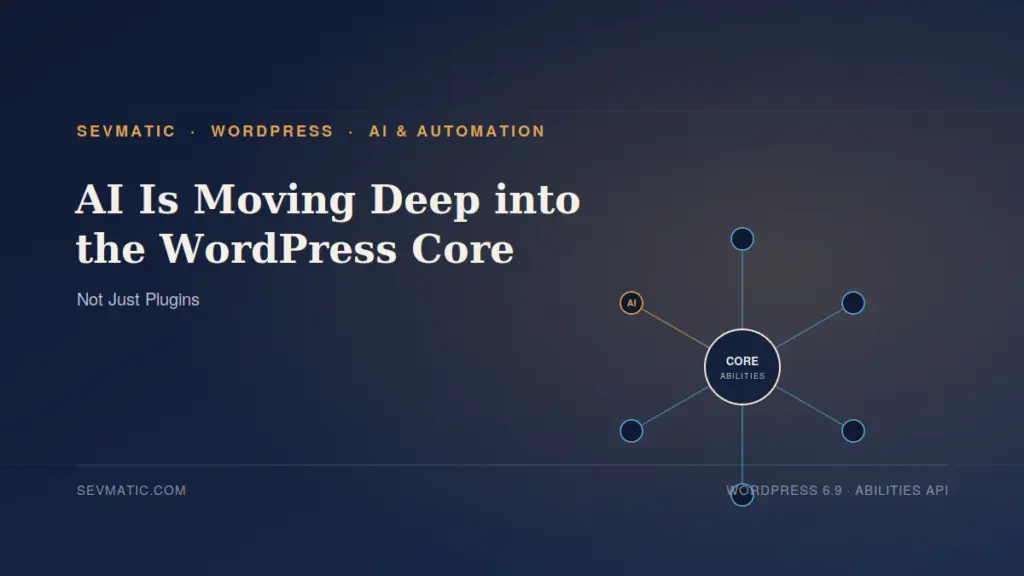
WordPress 6.9 introduced the Abilities API – a central registry system through which plugins, themes, and the core itself can register their capabilities in a standardized, machine-readable format. An “ability” is a self-contained unit of functionality with clearly defined inputs, outputs, permission checks, and execution logic:
php
wp_register_ability( 'sevmatic/create-post', array(
    'label'              => 'Create post',
    'description'        => 'Creates a new blog post with a title and content.',
    'input_schema'       => array(
        'type'       => 'object',
        'properties' => array(
            'title'   => array( 'type' => 'string' ),
            'content' => array( 'type' => 'string' ),
        ),
    ),
    'execute_callback'    => 'sevmatic_create_post',
    'permission_callback' => function() {
        return current_user_can( 'publish_posts' );
    },
) );
Once registered, an ability automatically becomes accessible across multiple interfaces – directly via PHP, via a dedicated REST route under wp-abilities/v1, and eventually via further interfaces still to come. Input and output validation happens via JSON Schema, and permissions are checked via a dedicated callback. For developers, this means: instead of hiding functionality inside isolated functions or custom AJAX endpoints, it becomes visible in a central, uniformly queryable registry.
The Link to AI Systems: Model Context Protocol
The Abilities API unfolds its real impact in combination with the Model Context Protocol (MCP) – an open standard through which AI assistants and applications can communicate with each other in a structured way. Through the MCP Adapter, a separate plugin, a WordPress installation’s abilities registry can be connected to AI providers such as Claude, ChatGPT, or Gemini. The result: an AI assistant can take a natural-language instruction like “Create a new blog post about our summer offer” and execute it directly through the site’s registered abilities – provided the corresponding permissions are in place.
Where This Is Heading: WP AI Client and Workflows API
The Abilities API is just the beginning. Two further building blocks have been announced for WordPress 7.0: a WP AI Client, providing a unified interface for connecting different AI models directly within the core, and a Workflows API, which will allow multi-step, automated processes to be defined on top of registered abilities. In parallel, an official repository for “WordPress Agent Skills” has emerged, and WP-Bench now exists as a benchmarking tool to measure how well different AI models handle WordPress-specific tasks.
Co-founder Matt Mullenweg sums up the direction under the banner of “Web OS”: WordPress isn’t meant to remain just a publishing platform, but to become the preferred infrastructure for how AI agents understand, extend, and operate websites. One visible building block of this: WordPress.org now also serves Markdown output – a format that’s considerably easier for AI agents to process than full HTML.
What This Means in Practice for Site Owners
For most existing WordPress installations, the Abilities API changes nothing visible at first – it’s a foundation for developers and automation tools, not a new control in the editor. It becomes relevant to the extent that plugins start registering their own functionality as abilities instead of continuing to build isolated AI integrations. In the medium term, this points toward AI assistants that no longer just perform individual, hard-coded tasks, but can flexibly access whatever functionality a specific WordPress installation actually provides – from creating a post, to setting up a product, to evaluating form submissions.
For developers of custom plugins or bespoke WordPress solutions, it’s already worth taking a look at the Abilities API: registering your own functionality as an ability today, rather than hiding it in a custom AJAX route, automatically makes it future-ready for upcoming AI workflows – without having to anticipate the details of those workflows in advance.
Our Take
The Abilities API is a classic piece of infrastructure: unspectacular at first glance, but with considerable leverage for everything that comes after it. Rather than leaving AI features as isolated solutions scattered across individual plugins, WordPress has for the first time created a shared language in which core, themes, and plugins can describe their capabilities – for developers and AI agents alike. For companies looking to keep their WordPress site future-proof in the long run, this is a good occasion to critically review existing custom developments and plugin architectures.
If you’d like to prepare your WordPress site or your own plugins for these new AI foundations, feel free to reach out. We support you from the initial assessment all the way through to implementation.
This article is a companion post to “WordPress + MCP in Practice”, which builds on the Abilities API described here to show a hands-on MCP integration.